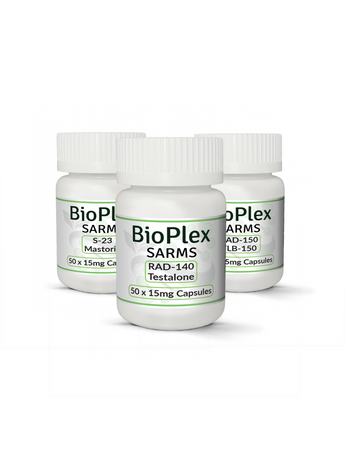


RAD-140 + RAD-150 + S-23
Kan beschikbaarheid voor afhalen niet laden
RAD-140 (Testolone) + RAD-150 (TLB-150) + S-23 (Mastorin) | SARMs Research UK
Advanced Androgen Signalling Research Set
The BioPlex Advanced Androgen Signalling Research Set combines RAD-140 (Testolone) 50×15mg, RAD-150 (TLB-150) 50×15mg and S-23 (Mastorin) 50×15mg, bringing together three research compounds associated with selective androgen-receptor signalling within one structured laboratory research set. The set contains one pot of each compound and provides a comparative framework for examining three chemically distinct molecules associated with androgen-receptor research.
RAD-140 is a non-steroidal selective androgen receptor modulator developed for investigation of tissue-selective androgen-receptor activity. Its research history makes Testolone one of the better recognised compounds within the modern SARM research category and provides an important reference point within this combination.
RAD-150, commonly identified as TLB-150, is positioned as a RAD-140-related research compound. Its relationship with Testolone makes it particularly interesting for comparative investigation, although the direct published evidence available specifically for RAD-150 remains considerably more limited than that surrounding RAD-140. Claims concerning differences in potency, duration or biological activity should therefore be treated as research hypotheses rather than automatically established facts.
S-23 provides the third androgen-receptor-associated component. It is a non-steroidal SARM with its own experimental history involving androgen-receptor activity and tissue-associated responses.
The Advanced Androgen Signalling Research Set therefore provides three separate compounds for investigating a common molecular research theme without assuming that their pharmacological behaviour is identical.
Its name reflects the focus on androgen-receptor signalling rather than guaranteeing any predetermined experimental outcome. Each compound remains independently identified, allowing differences in molecular structure, receptor activity and experimental evidence to be examined under controlled laboratory conditions.
How RAD-140, RAD-150 and S-23 Work Together
RAD-140, RAD-150 and S-23 are grouped within the Advanced Androgen Signalling Research Set because each is associated with androgen-receptor research. However, the scientific value of the combination lies in comparing their individual characteristics rather than assuming that three androgen-receptor-associated compounds automatically produce the same biological responses.
The androgen receptor belongs to the nuclear-receptor superfamily and functions as a ligand-responsive transcription factor. Interaction with a suitable ligand can alter receptor conformation and influence co-regulatory interactions and downstream expression of androgen-responsive genes. Selective androgen receptor modulators were developed partly to investigate whether different non-steroidal ligands could generate different patterns of activity across experimental tissues.
RAD-140 provides an established non-steroidal SARM research component. Its experimental history creates a useful reference for studying selective androgen-receptor signalling.
RAD-150 provides a closely related but much less extensively characterised comparison. Its association with RAD-140 makes structural and analytical comparison particularly relevant, while its limited direct evidence means conclusions concerning its exact pharmacological profile require caution.
S-23 expands the research framework through another structurally distinct selective androgen receptor modulator. Researchers can investigate its receptor-associated behaviour independently before comparing predefined experimental endpoints with RAD-140 and RAD-150.
The combination itself does not establish synergy between the three compounds. Nor should research findings involving RAD-140 automatically be transferred to RAD-150 or S-23. Receptor affinity, cellular environment, concentration, exposure and compound-specific characteristics can all influence observations.
The set instead provides a structured three-way comparison: an established Testolone research compound, a closely related RAD-150 compound with a developing evidence base and a separate S-23 SARM reference. This enables advanced comparative investigation of androgen-receptor signalling while maintaining compound-specific controls and evidence-based interpretation.
RAD-140 (Testolone) 50×15mg
RAD-140, commonly known as Testolone, is a synthetic non-steroidal selective androgen receptor modulator developed for experimental investigation of androgen-receptor signalling and tissue-selective responses. It belongs to the genuine SARM research category and provides the principal reference compound within the Advanced Androgen Signalling Research Set.
The androgen receptor is a ligand-responsive nuclear receptor capable of influencing transcription following interaction with appropriate molecules. When a ligand interacts with the receptor, changes in receptor conformation and subsequent co-regulatory interactions can influence expression of androgen-responsive genes.
RAD-140 research has focused on whether non-steroidal androgen-receptor ligands can demonstrate tissue-dependent patterns of activity. This concept of selective receptor modulation forms an important part of the scientific rationale behind SARM development.
Selective should not, however, be interpreted as meaning that RAD-140 acts exclusively within one tissue or produces a guaranteed experimental response. Receptor expression, concentration, cellular environment, exposure and experimental design can influence observed activity.
Within this triple research set, RAD-140 is particularly useful because RAD-150 is positioned as a closely related compound. This provides researchers with an opportunity to distinguish the comparatively better-established research profile of Testolone from claims and hypotheses surrounding the less extensively characterised TLB-150.
S-23 then provides a third structurally distinct androgen-receptor ligand for comparison.
RAD-140 therefore forms an important reference point across the combination. Researchers can examine its established androgen-receptor-associated characteristics independently before comparing selected molecular or cellular endpoints with RAD-150 and S-23.
This approach maintains the identity of each compound and prevents the shared SARM category from being interpreted as evidence that all three molecules possess identical receptor behaviour or downstream experimental profiles.
RAD-150 (TLB-150) 50×15mg
RAD-150, commonly identified as TLB-150, is a research compound closely associated with RAD-140 Testolone and frequently grouped within the selective androgen receptor modulator research category. Its relationship with RAD-140 makes it particularly relevant within this triple set, but its evidence base requires more cautious interpretation.
RAD-150 is commonly described within the research-compound market as a RAD-140-related or modified research molecule. However, the amount of accessible direct published pharmacological research specifically examining RAD-150 is considerably smaller than the evidence available for RAD-140.
This distinction is important because claims concerning a compound's potency, duration, receptor activity or experimental performance require compound-specific evidence. Characteristics demonstrated for RAD-140 should not automatically be assumed to apply to RAD-150 simply because the two compounds are chemically or commercially associated.
Within the Advanced Androgen Signalling Research Set, this evidence difference creates a useful comparative research question. RAD-140 provides the better-characterised Testolone reference, while RAD-150 provides a related molecule whose analytical and pharmacological characteristics can be investigated independently.
S-23 then provides a third SARM research compound that is not part of the RAD series, allowing researchers to extend comparison beyond closely related molecules.
Research involving RAD-150 should therefore maintain appropriate compound identification and independent experimental controls. Observed responses need to be attributed to RAD-150 itself rather than inferred from Testolone research.
Its inclusion within this set is particularly valuable for investigating similarities and differences between compounds positioned within the same broader androgen-receptor research category.
Rather than presenting RAD-150 as simply a stronger or longer-lasting version of RAD-140, the BioPlex research approach maintains the distinction between established evidence and claims requiring further experimental validation.
S-23 (Mastorin) 50×15mg
S-23, presented within the BioPlex research range as Mastorin, is a synthetic non-steroidal selective androgen receptor modulator investigated for its interaction with androgen receptors and associated tissue-dependent experimental responses. It provides the third distinct SARM component within the Advanced Androgen Signalling Research Set.
Like RAD-140, S-23 belongs to the broader category of non-steroidal androgen-receptor ligands developed to investigate selective receptor modulation. However, classification within the same category does not mean that S-23 and RAD-140 are pharmacologically interchangeable.
Different molecular structures can influence receptor affinity, receptor conformation, co-regulatory interactions, concentration-response relationships and downstream transcriptional activity. These differences form an important part of comparative SARM research.
S-23 has an experimental history involving androgen-receptor-associated activity and reproductive-endocrine research models. This provides a distinct evidence profile from RAD-140 and an even clearer distinction from the considerably less characterised RAD-150.
Within this triple set, S-23 therefore broadens the comparison. RAD-140 provides an established Testolone reference, RAD-150 provides a closely related but less extensively studied research compound, and S-23 provides an independently developed selective androgen receptor modulator.
Researchers can examine S-23-specific responses before comparing predefined endpoints across all three compounds. This may include receptor-associated, transcriptional or other experimentally appropriate measurements selected according to the laboratory model being used.
The presence of three androgen-receptor-associated compounds does not itself establish a combined or synergistic response. Compound concentration, exposure, receptor expression and experimental conditions remain critical variables.
S-23 consequently contributes an independent androgen-receptor research pathway to the combination, allowing the Advanced Androgen Signalling Research Set to support broader comparative investigation rather than simply comparing the two closely associated RAD compounds.
Explore Related Research Compounds
Continue exploring related selective androgen receptor modulators from the BioPlex SARMs capsule range.
View RAD-140 Testolone 50×15mg Research Capsules ⟶
Explore RAD-150 TLB-150 50×15mg Research Capsules ⟶
Explore S-23 Mastorin 50×15mg Research Capsules ⟶
Explore BioPlex Research Information
Access BioPlex SARMs guidance, compound classification and the complete research product range.
Read the Complete SARMs UK Research Compound Guide ⟶
Explore the BioPlex SARMs Research Range ⟶
View All BioPlex Research Products ⟶
Explore Related Research Articles
Continue your research with BioPlex articles covering RAD-140 Testolone, RAD-150 TLB-150, selective androgen-receptor signalling and related SARM research.
Read the RAD-140 Testolone Research Overview ⟶
Read the RAD-150 TLB-150 Research Overview ⟶
Explore All BioPlex SARMs Research Articles ⟶
Disclaimer

More Ways to Pay — Coming Soon...
Why Thousands Choose BioPlex Peptides..
BioPlex has built its reputation through consistency, transparency and a long term commitment to quality. With peptide sector experience dating back to 2012, we've grown into one of the UK's most trusted research suppliers by focusing on high quality research products, independent verification and customer confidence—not empty marketing claims!
Explore BioPlex Research Collections
Browse research peptides UK, peptide sets, amino acids, SARMs, reconstitution solutions and the complete BioPlex product range.


Top Selling Product of 2026-Klow 80mg
KLOW is an 80mg multi-peptide research blend combining GHK-Cu, BPC-157, TB-500 and KPV. It supports controlled laboratory investigation into cellular signalling, extracellular matrix regulation, peptide interactions, inflammatory markers and coordinated tissue-response pathways.


Klow Stack 80mg
Kan beschikbaarheid voor afhalen niet laden
Your Recently Viewed Products...
Take another look at recently viewed products and continue exploring the BioPlex range.
New Research Arrivals & Liquid Amino-Acid Blends


Latest Articles From BioPlex ...
Research insights, industry updates and practical guidance from BioPlex Peptides.


Discover Our Sister Store — LoveVella
From the BioPlex family, discover LoveVella, our online adult and lifestyle store with thousands of products for women, men and couples. BioPlex customers can enjoy 15% off their LoveVella order.
CODE: BIOPLEXCUSTOMER
View The Sister Store⟶