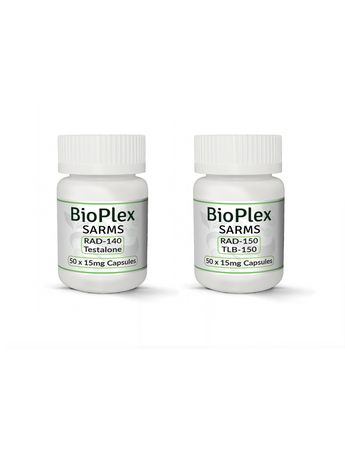


RAD-140 + RAD-150
Teslim alım stok durumu yüklenemedi
RAD-140 (Testolone) + RAD-150 (TLB-150) | SARMs Research UK
Advanced Androgen Signalling Research Set
The BioPlex Advanced Androgen Signalling Research Set combines RAD-140 (Testolone) 50×15mg and RAD-150 (TLB-150) 50×15mg, bringing together two closely related selective androgen receptor modulator research compounds for comparative laboratory investigation. The set contains one pot of each compound and is particularly relevant to research examining androgen-receptor signalling, molecular modification, tissue-selective pathways and the differences that may exist between a better-characterised parent compound and a structurally related derivative.
RAD-140 is a non-steroidal selective androgen receptor modulator with a comparatively established research history. Published investigation has examined its androgen-receptor activity, tissue-selective pharmacology and behaviour across preclinical models, with additional specialised clinical research adding to its scientific evidence base. RAD-150, also known as TLB-150 or TLB-150 Benzoate, is commonly described in the research-compound field as a modified benzoate analogue related to RAD-140. However, the direct published evidence available specifically for RAD-150 is substantially more limited. BioPlex's existing RAD-150 research material makes this distinction explicitly rather than treating evidence for RAD-140 as though it automatically applies to RAD-150.
This relationship makes the pairing particularly useful from a comparative research perspective. Researchers can examine the established androgen-receptor framework surrounding RAD-140 while considering how structural modification may affect molecular identity, analytical characteristics and hypotheses concerning compound behaviour.
The Advanced Androgen Signalling Research Set name reflects this shared scientific pathway rather than suggesting a predetermined experimental result. Similarity between two compounds does not establish identical pharmacology.
By presenting RAD-140 and RAD-150 together while preserving the distinction between their evidence bases, BioPlex provides a structured research pairing for examining two related compounds within androgen-receptor and SARM research.
How RAD-140 and RAD-150 Work Together
RAD-140 (Testolone) and RAD-150 (TLB-150) are closely connected within selective androgen receptor modulator research because RAD-150 is commonly described as a structurally modified, benzoate-related analogue of RAD-140. This makes the combination different from a pairing of two unrelated SARMs. Instead, it creates an opportunity to investigate a better-characterised parent research compound alongside a closely related derivative within the same androgen-receptor research framework.
RAD-140 is studied principally through the androgen receptor, a ligand-activated nuclear receptor involved in regulation of androgen-responsive gene transcription. Ligand interaction can initiate changes in receptor conformation and subsequent processes involving co-regulatory proteins, nuclear signalling and transcriptional activity. RAD-140 research has provided a comparatively substantial foundation for investigating these processes.
RAD-150 is discussed through the same broad androgen-receptor research area because of its structural relationship to RAD-140. However, this relationship must be interpreted carefully. Direct published pharmacological evidence specifically characterising RAD-150 remains limited compared with RAD-140. Claims that RAD-150 necessarily produces extended activity, different potency or superior experimental outcomes should therefore not be presented as established findings. BioPlex's RAD-150 research overview specifically identifies this evidence gap.
The scientific interest in placing these compounds together consequently lies in comparative investigation. Structural modification may affect molecular weight, analytical identity, solubility, stability, exposure or other experimental characteristics, but each variable requires appropriate measurement rather than assumption.
Grouping RAD-140 and RAD-150 together also does not establish additive or synergistic activity. Instead, the pairing provides a controlled framework for examining molecular relationship, androgen-receptor signalling, compound identity and potentially differing experimental behaviour.
This makes careful analytical verification particularly important. Appropriate controls and compound-specific identification allow observations involving RAD-150 to remain separate from established RAD-140 evidence while still permitting meaningful comparison between the related molecules.
RAD-140 (Testolone) 50×15mg
RAD-140, commonly known as Testolone and investigated clinically under the name Vosilasarm, is a synthetic non-steroidal selective androgen receptor modulator. It was developed within research exploring whether androgen-receptor signalling could be modulated selectively across different tissue environments, creating an important experimental compound for investigating receptor pharmacology, transcriptional responses and tissue-associated signalling.
The principal molecular target of RAD-140 is the androgen receptor. This receptor belongs to the nuclear-receptor family and functions as a ligand-responsive regulator of gene transcription. Following interaction with a suitable ligand, changes in receptor conformation and associated cellular processes can influence androgen-responsive transcription. The resulting biological observations depend upon the experimental system, receptor expression, co-regulator availability, concentration, exposure and selected endpoints.
RAD-140 has considerably more direct published research than RAD-150. Its research history includes receptor-focused investigation and preclinical studies examining tissue-selective activity. It has also progressed into specialised clinical research, providing a broader evidence base than is available for many experimental SARMs.
That evidence remains important when RAD-140 is paired with a structurally related compound. Researchers have a comparatively established scientific framework against which analytical and experimental observations concerning RAD-150 can be considered.
RAD-140 should nevertheless not be treated as a universal proxy for RAD-150. A structural relationship does not establish identical molecular behaviour, exposure or biological response. Each compound requires its own identification and experimental interpretation.
Within the Advanced Androgen Signalling Research Set, RAD-140 therefore serves as the better-characterised component of the pairing. Its established association with androgen-receptor research provides a useful reference point for examining how a structurally related derivative may compare while avoiding the assumption that evidence from the parent compound automatically proves the characteristics of RAD-150.
RAD-150 (TLB-150) 50×15mg
RAD-150, commonly identified as TLB-150 or TLB-150 Benzoate, is a non-peptide research compound associated with the selective androgen receptor modulator category. It is commonly described as a modified benzoate-related analogue of RAD-140 Testolone, which explains why RAD-150 and RAD-140 frequently appear together in research-compound comparisons and analytical discussions.
This relationship is scientifically interesting but requires careful interpretation. RAD-150 does not currently possess the same depth of direct published pharmacological evidence as RAD-140. Much of the discussion surrounding RAD-150 derives from its structural relationship to the better-characterised RAD-140 molecule rather than from a large body of independent experimental studies. BioPlex's existing RAD-150 Research Overview explicitly highlights this distinction.
RAD-150 is generally discussed within androgen-receptor signalling research. This can include investigation of receptor interaction, tissue-selective signalling models, transcriptional pathways and analytical comparison with related selective androgen receptor modulators. However, characteristics proposed online for RAD-150 should not be considered scientifically established merely because related effects or mechanisms have been investigated for RAD-140.
The structural modification itself also creates an important analytical research area. Changes to molecular structure can affect molecular mass, identity profile, solubility, stability and other physicochemical characteristics. Appropriate analytical techniques are therefore especially valuable when distinguishing RAD-150 from RAD-140 and confirming that the material being investigated corresponds to the intended compound.
Within the Advanced Androgen Signalling Research Set, RAD-150 provides the less extensively characterised side of a closely related molecular pairing. This allows researchers to examine a newer SARM-category research compound alongside its better-documented relative while clearly separating established evidence from hypotheses.
BioPlex supplies RAD-150 as a 50×15mg research capsule product and currently lists it at £38.99, reduced from its regular £48.99 price.
Explore Related Research Compounds
Continue exploring related androgen-receptor and SARMs-category research compounds from BioPlex.
View RAD-140 Testolone 50×15mg Research Capsules ⟶
View RAD-150 TLB-150 50×15mg Research Capsules ⟶
Explore All BioPlex SARMs Research Compounds ⟶
Explore BioPlex Research Information
Access BioPlex SARMs guidance, compound classification and the complete research product range.
Read the Complete SARMs UK Research Compound Guide ⟶
Explore the BioPlex SARMs Research Range ⟶
View All BioPlex Research Products ⟶
Explore Related Research Articles
Continue your research with BioPlex articles covering RAD-140, RAD-150, androgen-receptor signalling and the structural relationship between these two research compounds.
Read the RAD-150 TLB-150 Research Overview ⟶
Read the RAD-140 Testolone Research Overview ⟶
Explore All BioPlex SARMs Research Articles ⟶
Disclaimer

More Ways to Pay — Coming Soon...
Why Thousands Choose BioPlex Peptides..
BioPlex has built its reputation through consistency, transparency and a long term commitment to quality. With peptide sector experience dating back to 2012, we've grown into one of the UK's most trusted research suppliers by focusing on high quality research products, independent verification and customer confidence—not empty marketing claims!
Explore BioPlex Research Collections
Browse research peptides UK, peptide sets, amino acids, SARMs, reconstitution solutions and the complete BioPlex product range.


Top Selling Product of 2026-Klow 80mg
KLOW is an 80mg multi-peptide research blend combining GHK-Cu, BPC-157, TB-500 and KPV. It supports controlled laboratory investigation into cellular signalling, extracellular matrix regulation, peptide interactions, inflammatory markers and coordinated tissue-response pathways.


Klow Stack 80mg
Teslim alım stok durumu yüklenemedi
Your Recently Viewed Products...
Take another look at recently viewed products and continue exploring the BioPlex range.
New Research Arrivals & Liquid Amino-Acid Blends


Latest Articles From BioPlex ...
Research insights, industry updates and practical guidance from BioPlex Peptides.


Discover Our Sister Store — LoveVella
From the BioPlex family, discover LoveVella, our online adult and lifestyle store with thousands of products for women, men and couples. BioPlex customers can enjoy 15% off their LoveVella order.
CODE: BIOPLEXCUSTOMER
View The Sister Store⟶