

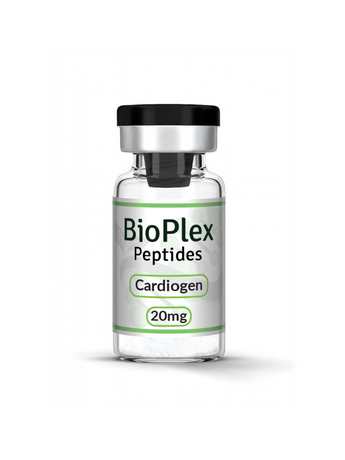


Cardiogen 20mg (AEDR Peptide Bioregulator)
Não foi possível carregar a disponibilidade para recolha
Premium Grade | UK Supply | Research Peptide | COA Certified | >99% Purity | Worldwide Delivery
(Tetrapeptide, 4 amino acids)
Brief Summary
Cardiogen is a short synthetic peptide research compound studied in laboratory settings for its relationship with cardiac tissue signalling, cellular proliferation and peptide bioregulation. Consisting of the four-amino-acid sequence alanine–glutamic acid–aspartic acid–arginine, commonly abbreviated as AEDR, Cardiogen belongs to a group of short regulatory peptides investigated for tissue-associated molecular activity. It is commonly examined in structured research models involving myocardial tissue, cardiomyocyte response patterns, fibroblast behaviour, gene-expression markers and cellular stress pathways. Experimental studies have reported changes in proliferative activity and apoptosis-associated markers within cardiac tissue cultures, although the available evidence remains primarily preclinical and requires further investigation. Within scientific supply catalogues, Cardiogen is valued for in vitro and controlled laboratory studies focused on short-peptide signalling, tissue-specific response analysis, cellular regulation and comparative peptide bioregulator research. Its compact structure, defined molecular composition and reproducible sequence make it suitable for professional research environments requiring clear identification, documented analytical handling and consistent research-focused product standards.
Product Overview
Cardiogen is a laboratory-grade synthetic tetrapeptide developed for research examining cardiac tissue regulation, peptide-mediated cellular communication and short-sequence bioregulator activity. Its sequence, Ala–Glu–Asp–Arg, contains four chemically distinct amino acids that provide acidic, basic and neutral side-chain characteristics within one compact molecule. Unlike larger peptides that depend on complex secondary structures, Cardiogen offers a simplified model for investigating how very short amino-acid sequences may influence cellular behaviour and molecular response patterns. Laboratory research has examined Cardiogen in myocardial tissue cultures from different age groups, with particular attention given to cardiomyocyte proliferation, fibroblast-associated activity and apoptosis-related protein expression. Other investigations have considered its possible interaction with gene-regulatory processes, nucleic-acid-associated enzymes and cellular stress-response mechanisms. Its defined molecular formula, low molecular weight and reproducible AEDR sequence support controlled analytical studies involving peptide identity, sequence-specific behaviour, tissue-associated signalling and comparative investigation against individual amino acids or other short peptide bioregulators.
Scientific Background
From a molecular science perspective, Cardiogen is studied as a short peptide bioregulator associated with cardiovascular tissue models and gene-expression-related research. Experimental work using myocardial tissue cultures reported that the AEDR tetrapeptide produced a stronger proliferative response than the individual amino acids from which it is formed, suggesting that peptide-bonded sequence organisation may create molecular behaviour not reproduced by an unlinked amino-acid mixture. Research has also examined changes in p53 protein expression, a marker closely connected with cell-cycle control, cellular stress and apoptosis signalling. Separate molecular studies of short regulatory peptides have explored their interaction with histones, DNA-associated systems and endonuclease activity, providing a wider framework for investigating how compact peptide sequences may influence transcriptional or epigenetic processes. Cardiogen therefore provides a useful experimental model for studying sequence-specific peptide effects, cardiomyocyte and fibroblast response patterns, intracellular regulation and the relationship between short peptide structure and tissue-associated molecular activity. Current evidence is largely based on laboratory and preclinical models rather than established clinical application.
Research Applications
Cardiogen is applied in laboratory research across peptide science, cardiovascular biology, molecular regulation and cellular signalling disciplines. Researchers utilise the AEDR tetrapeptide to examine myocardial tissue proliferation, cardiomyocyte response patterns, fibroblast-associated signalling, extracellular matrix regulation and apoptosis-related molecular markers under controlled experimental conditions. Its short sequence also supports comparative studies evaluating the behaviour of a complete tetrapeptide against its four individual amino-acid components. Additional research applications include investigations into peptide-dependent gene-expression patterns, cellular stress responses, p53-associated signalling, tissue-age comparisons and molecular mechanisms that may influence cardiac remodelling models. Cardiogen has also been examined in preclinical tumour models, where researchers evaluated apoptosis, necrosis and dose-dependent cellular responses, demonstrating that its investigational scope extends beyond a single tissue pathway. These applications support deeper understanding of how compact peptide bioregulators may influence cellular communication, proliferation and transcription-related processes while providing a defined analytical compound for controlled in vitro, tissue-culture and preclinical research design.
Technical Specifications
Contents: 20mg Cardiogen
Form: Lyophilised powder
Purity: >99% (HPLC Verified)
Molecular Formula: C₁₈H₃₁N₇O₉
Molecular Weight: 489.47 g/mol
Sequence: Alanine–Glutamic Acid–Aspartic Acid–Arginine
Sequence: AEDR
Peptide Length: 4 amino acids
pH Range: Refer to batch-specific documentation and experimental protocol
Storage: Store between 2°C and 8°C in accordance with the product documentation
Note: Reconstitute with Bacteriostatic Water
Explore Related Research Compounds
Continue exploring related laboratory research products from BioPlex Peptides.
View SLUPP-5mg Research Compound ⟶
View ACE-031 1mg Research Blend ⟶
View Follistatin 1mg 10mg Research Blend ⟶
Research Preparation and Storage
Access BioPlex solutions, calculation tools and storage guidance for accurate and consistent laboratory preparation.
View Reconstitution Solutions ⟶
Use the Peptide Reconstitution Calculator ⟶
Read the Peptide Types and Storage Guide ⟶
Explore Related Research Articles
Continue your research with detailed BioPlex articles covering compound structures, scientific mechanisms and laboratory research pathways.
Disclaimer

More Ways to Pay — Coming Soon...
Why Thousands Choose BioPlex Peptides..
BioPlex has built its reputation through consistency, transparency and a long term commitment to quality. With peptide sector experience dating back to 2012, we've grown into one of the UK's most trusted research suppliers by focusing on high quality research products, independent verification and customer confidence—not empty marketing claims!
Explore BioPlex Research Collections
Browse research peptides UK, peptide sets, amino acids, SARMs, reconstitution solutions and the complete BioPlex product range.


Top Selling Product of 2026-Klow 80mg
KLOW is an 80mg multi-peptide research blend combining GHK-Cu, BPC-157, TB-500 and KPV. It supports controlled laboratory investigation into cellular signalling, extracellular matrix regulation, peptide interactions, inflammatory markers and coordinated tissue-response pathways.


Klow Stack 80mg
Não foi possível carregar a disponibilidade para recolha
Your Recently Viewed Products...
Take another look at recently viewed products and continue exploring the BioPlex range.
New Research Arrivals & Liquid Amino-Acid Blends


Latest Articles From BioPlex ...
Research insights, industry updates and practical guidance from BioPlex Peptides.


Discover Our Sister Store — LoveVella
From the BioPlex family, discover LoveVella, our online adult and lifestyle store with thousands of products for women, men and couples. BioPlex customers can enjoy 15% off their LoveVella order.
CODE: BIOPLEXCUSTOMER
View The Sister Store⟶







)