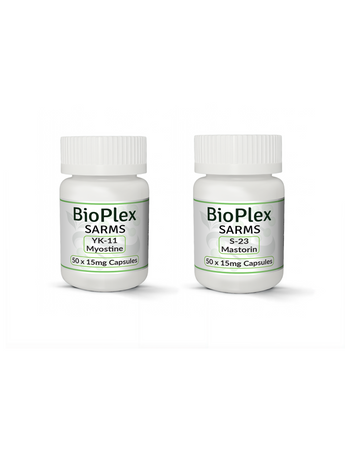
YK-11 + S-23

£91.99 £82.99 Save 10%
Tax included. Shipping calculated at checkout.

YK-11 (Myostine) + S-23 (Mastorin) | SARMs Research UK

Myogenic Growth Pathway Research Set

The BioPlex Myogenic Growth Pathway Research Set combines YK-11 (Myostine) 50×15mg and S-23 (Mastorin) 50×15mg, bringing together two experimental compounds associated with androgen-receptor research while offering distinctly different scientific profiles. The set contains one pot of each compound and provides a structured pairing for comparative laboratory investigation of androgen-receptor signalling, myogenic pathways and compound-specific molecular responses.

YK-11 occupies an unusual position within the wider SARM research category. It is commonly grouped with selective androgen receptor modulators because research has demonstrated androgen-receptor-related activity, but its structure and available experimental evidence distinguish it from more conventional non-steroidal SARMs. Particular research interest has developed around its reported relationship with myogenic signalling and follistatin-associated observations, although these findings originate  primarily from limited cellular research and require careful interpretation.

S-23, commonly known as Mastorin, is an experimental non-steroidal selective androgen receptor modulator investigated principally through androgen-receptor pathways. Its research profile therefore provides a useful comparison with YK-11, allowing two compounds associated with the same broad receptor system to be examined while recognising significant differences in their molecular structures and evidence bases.

The Myogenic Growth Pathway Research Set name reflects the scientific theme connecting the compounds rather than guaranteeing any particular experimental result. Myogenic signalling involves a complex network of receptors, transcription factors and regulatory proteins, and findings from one experimental system cannot automatically be transferred to another.

Bringing YK-11 and S-23 together consequently creates a research pairing centred on androgen-receptor biology while allowing YK-11's additional myogenic research questions to be considered separately. Both products remain individually identified 50×15mg capsule compounds supplied strictly for laboratory, analytical and educational research.


How YK-11 and S-23 Work Together

YK-11 (Myostine) and S-23 (Mastorin) are both associated with androgen-receptor research, providing the principal scientific connection between the compounds. The androgen receptor is a ligand-regulated nuclear receptor capable of influencing transcription of androgen-responsive genes following interaction with an appropriate ligand. Differences between individual ligands can nevertheless result in substantially different experimental profiles.

S-23 fits more conventionally within the non-steroidal selective androgen receptor modulator category. Research involving the compound has focused on androgen-receptor activity and downstream responses across experimental models. YK-11 is more unusual. Although it demonstrates androgen-receptor-associated activity, its steroidal structural characteristics and limited evidence base mean it should not simply be treated as equivalent to conventional SARMs.

The additional research interest surrounding YK-11 comes from cellular studies examining myogenic differentiation and follistatin-associated expression. Follistatin is a regulatory protein capable of interacting with members of the transforming growth factor-beta superfamily, including activin-related signalling pathways. This has contributed to wider discussion of YK-11 in relation to myostatin-associated research, but the distinction between observed cellular findings and established whole-system effects is essential.

Pairing YK-11 with S-23 therefore provides a framework for studying shared androgen-receptor biology alongside potentially different downstream signalling characteristics. Researchers may compare receptor-associated responses, transcriptional markers and predetermined cellular endpoints while separately examining YK-11-specific hypotheses involving myogenic regulatory pathways.

The combination does not establish that the compounds are synergistic or that one enhances the activity of the other. Their different molecular characteristics, evidence levels and experimental histories make controlled comparison more appropriate than assuming a predetermined combined response.

The research value of this pairing therefore lies in investigating two distinct androgen-receptor-associated compounds within a common experimental framework while maintaining clear separation between established receptor pharmacology, preliminary cellular findings and hypotheses requiring further investigation.


YK-11 (Myostine) 50×15mg

YK-11, commonly known as Myostine within the research-compound market, is an experimental androgen-receptor-associated compound that has attracted particular interest because of its unusual pharmacological and structural characteristics. Although frequently placed within the SARM category, YK-11 differs structurally from many better-known non-steroidal selective androgen receptor modulators and has a considerably smaller direct evidence base.

Laboratory research has demonstrated androgen-receptor-associated activity, making receptor signalling an important part of YK-11 investigation. However, much of the wider scientific interest surrounding the compound originates from cellular research examining myogenic differentiation and associated regulatory pathways rather than extensive clinical investigation.

One frequently discussed area involves follistatin. Cellular research has reported changes in follistatin expression following YK-11 exposure under specific experimental conditions. Follistatin participates in complex signalling networks and can bind selected members of the TGF-beta superfamily. This relationship has led YK-11 to become widely discussed in connection with myostatin-related research.

That interpretation requires caution. Evidence of altered follistatin expression in a cellular model does not establish that YK-11 directly blocks myostatin or produces a predetermined tissue response across different biological systems. Myogenesis involves multiple interacting signalling pathways, transcription factors and regulatory proteins. Experimental model, concentration, exposure duration and endpoint selection can materially affect results.

This limited evidence base is one reason YK-11 is scientifically interesting within the Myogenic Growth Pathway Research Set. Rather than presenting hypotheses as established facts, researchers can examine its androgen-receptor-associated characteristics alongside selected myogenic markers and compare those observations with a more conventional SARM-category compound such as S-23.

Within this set, YK-11 therefore provides the myogenic-signalling-focused side of the pairing while retaining its relationship with wider androgen-receptor research.


S-23 (Mastorin) 50×15mg

S-23, commonly known as Mastorin within the research-compound market, is an experimental non-steroidal selective androgen receptor modulator studied principally for its interaction with the androgen receptor. Its pharmacological classification places it within the genuine SARM research category, distinguishing it from related compounds sometimes sold alongside SARMs that instead target completely different molecular pathways.

The androgen receptor functions as a ligand-activated nuclear receptor and transcriptional regulator. Following interaction with an appropriate ligand, receptor conformation and co-regulatory interactions can change, potentially altering transcription of androgen-responsive genes. S-23 research is therefore centred primarily on this receptor system and downstream experimental responses associated with its modulation.

S-23 remains an investigational compound. Its research history includes preclinical investigation, but this does not establish approved applications or allow observations from experimental models to be generalised beyond the conditions studied. Concentration, exposure, tissue environment, receptor expression and experimental methodology remain important variables when interpreting findings.

Within this set, S-23 provides an interesting counterpart to YK-11. Both compounds are associated with androgen-receptor research, but their molecular characteristics and evidence profiles differ. YK-11 has generated additional research interest around myogenic and follistatin-associated observations, whereas S-23 provides a more conventional selective androgen receptor modulator framework.

This distinction allows researchers to consider common androgen-receptor signalling while examining whether compound-specific molecular characteristics correspond with different downstream observations. It also prevents the broad SARM classification from obscuring meaningful differences between the two molecules.

Within the BioPlex Myogenic Growth Pathway Research Set, S-23 therefore provides the second androgen-receptor-focused component of a comparative research pairing and complements the more specialised myogenic research questions associated with YK-11.


Explore Related Research Compounds

Continue exploring related androgen-receptor and SARMs-category research compounds from BioPlex.

View YK-11 Myostine 50×15mg Research Capsules ⟶

View S-23 Mastorin 50×15mg Research Capsules ⟶

View RAD-140 Testolone 50×15mg Research Capsules ⟶


Explore BioPlex Research Information

Access BioPlex SARMs guidance, compound classification and the complete research product range.

Read the Complete SARMs UK Research Compound Guide ⟶

Explore the BioPlex SARMs Research Range ⟶

View All BioPlex Research Products ⟶


Explore Related Research Articles

Continue your research with BioPlex articles covering SARMs, androgen-receptor signalling, YK-11-related research pathways and compound classification.

Read the Complete Guide to SARMs UK: Research Compounds Explained ⟶

Read the RAD-140 Testolone Research Overview ⟶

Explore All BioPlex SARMs Research Articles ⟶


Disclaimer

For research purposes only. Not for human consumption


Explore BioPlex Research Collections

Browse research peptides UK, peptide sets, amino acids, SARMs, reconstitution solutions and the complete BioPlex product range.

Pay With "Wise"

Set Up Wise Here-Works Just Like PayPal. Just Add Your card And Pay In Minutes... Great For International Payments!

Apply Now!

Your Recently Viewed Products...

Take another look at recently viewed products and continue exploring the BioPlex range.

New Research Arrivals & Liquid Amino-Acid Blends

Explore the latest BioPlex Peptides product additions, including our new liquid Amino-Acid research range. This collection features premium grade research compounds developed for controlled laboratory investigation into metabolism, cellular energy, recovery pathways, nutrient cofactors and specialist biochemical study models. Supplied from the UK with worldwide delivery.