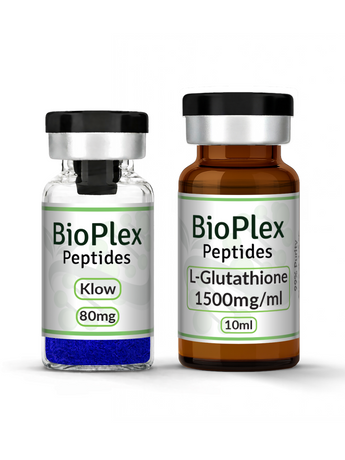


Klow 80mg
L-Glutathione 1500mg
Couldn't load pickup availability
Premium Grade | UK Supply | Research Peptide | COA Certified | >99% Purity | Worldwide Delivery
(KLOW Stack 80mg – GHK-Cu 50mg, BPC-157 10mg, TB-500 10mg and KPV 10mg)
(L-Glutathione 1500mg – Antioxidant Tripeptide, 3 Amino Acids)
Why KLOW and L-Glutathione Make a Strong Research Pairing
KLOW 80mg and L-Glutathione 1500mg form a scientifically relevant research pairing because they bring together complementary biochemical pathways associated with cellular signalling, extracellular matrix regulation, oxidative stress responses, inflammatory signalling and cellular redox balance. Although both products are relevant to tissue associated and cellular research, they provide different molecular perspectives. KLOW combines four research peptides investigated for their involvement in cellular communication, cytoskeletal organisation and regulatory pathways, while L-Glutathione introduces an important antioxidant tripeptide associated with intracellular redox regulation and enzyme dependent cellular defence mechanisms.
KLOW 80mg is a specialist four-peptide research blend containing GHK-Cu 50mg, BPC-157 10mg, TB-500 10mg and KPV 10mg. Each peptide contributes a distinct molecular research profile. GHK-Cu is a copper binding tripeptide investigated for its relationship with collagen associated signalling, extracellular matrix organisation and copper-dependent cellular processes. BPC-157 is a synthetic pentadecapeptide studied in preclinical models involving fibroblast activity, nitric oxide associated signalling, cellular migration and inflammatory response pathways. TB-500 is associated with thymosin beta-4 research and is investigated in relation to actin dynamics, cytoskeletal organisation and cellular movement. KPV is a three amino acid peptide studied for its relationship with inflammatory signalling and cellular regulatory mechanisms.
L-Glutathione is a naturally occurring tripeptide composed of glutamic acid, cysteine and glycine. It is one of the most extensively studied compounds in cellular redox biology because of its involvement in oxidation reduction reactions, intracellular antioxidant systems and biochemical pathways associated with cellular protection. L-Glutathione exists in reduced and oxidised forms, commonly identified as GSH and GSSG, which participate in interconnected reactions involved in maintaining cellular redox conditions. Scientific investigations examine its relationship with reactive oxygen species, glutathione peroxidase activity, glutathione reductase function and glutathione dependent enzyme systems.
Studying KLOW and L-Glutathione within the same research programme provides an opportunity to investigate how peptide-mediated cellular communication relates to antioxidant-associated biochemical processes. KLOW offers a broad research route into extracellular matrix biology, cellular migration, copper peptide signalling and inflammatory response mechanisms, while L-Glutathione contributes a complementary research profile involving oxidative stress markers, glutathione enzyme systems and intracellular redox regulation. These distinct but related research pathways allow investigators to examine how cellular signalling and redox conditions influence broader tissue-associated experimental models.
One area of particular scientific interest is the relationship between GHK-Cu associated extracellular matrix research and the antioxidant systems represented by L-Glutathione. GHK-Cu has been investigated for its potential involvement in collagen related gene expression, fibroblast behaviour and copper dependent cellular processes. Copper is an essential element in several biological enzyme systems, including enzymes associated with antioxidant defence and structural tissue metabolism. L-Glutathione participates in maintaining intracellular thiol balance and contributes to the biochemical environment in which redox sensitive cellular processes operate. Examining these pathways provides a useful framework for investigating relationships between copper peptide signalling, cellular oxidative conditions and extracellular matrix regulation.
BPC-157 and TB-500 introduce additional research dimensions involving cellular movement, tissue-response signalling and cytoskeletal organisation. BPC-157 is investigated in preclinical studies examining fibroblast activity, nitric oxide-related pathways and angiogenesis-associated markers, while TB-500 research is connected with actin regulation and mechanisms involved in cellular structure and migration. Oxidative stress can influence these cellular processes through changes in redox-sensitive signalling proteins and the regulation of cytoskeletal activity. L-Glutathione therefore provides a relevant biochemical research perspective for examining how intracellular redox conditions relate to cellular migration, signalling responses and structural organisation.
KPV adds another important molecular research component through its association with inflammatory signalling pathways. KPV is a tripeptide derived from the C-terminal sequence of alpha melanocyte stimulating hormone and has been investigated in experimental models involving inflammatory mediator activity and regulatory signalling. Scientific interest includes its relationship with NF-kappa B-associated pathways, cytokine expression and cellular inflammatory response mechanisms. L-Glutathione is also relevant to inflammatory research because intracellular redox conditions can influence the activity of signalling proteins involved in cellular stress responses. Together, these compounds provide complementary research subjects for examining the relationship between peptide-associated inflammatory signalling and antioxidant-dependent biochemical regulation.
The pairing is particularly relevant to laboratory investigations involving oxidative stress and extracellular matrix biology. Cellular responses to oxidative conditions can influence protein activity, gene expression, collagen associated pathways and cellular communication. KLOW provides multiple peptide research components associated with matrix organisation, cellular migration and regulatory signalling, while L-Glutathione offers a direct route into antioxidant enzyme activity and redox homeostasis. These research profiles provide opportunities to investigate how extracellular matrix associated processes and intracellular oxidative conditions relate to broader cellular response mechanisms.
Another important research area involves mitochondrial function and cellular metabolic regulation. Mitochondria participate in energy production and are also involved in the generation and regulation of reactive oxygen species. Glutathione dependent systems contribute to mitochondrial redox balance and the regulation of oxidative biochemical conditions. The peptides within KLOW are investigated across distinct cellular signalling pathways that may be examined alongside mitochondrial and metabolic markers in appropriately designed experimental models. This provides a wider research perspective on the relationship between peptide mediated cellular communication, energy associated biochemical activity and intracellular antioxidant systems.
The combination also offers a scientifically relevant framework for investigating cellular responses involving collagen associated markers, inflammatory signalling and redox-sensitive gene expression. GHK-Cu introduces copper peptide research associated with structural tissue biology, BPC-157 and TB-500 contribute preclinical pathways involving cellular migration and cytoskeletal regulation, and KPV provides a distinct inflammatory signalling research component. L-Glutathione extends these research themes through its relationship with intracellular thiol chemistry, antioxidant enzyme activity and oxidative stress-associated regulatory processes. The result is a broad set of interconnected research subjects suitable for comparative investigation within controlled laboratory environments.
Relevant experimental endpoints may include collagen associated gene expression, fibroblast activity, cellular migration rates, extracellular matrix organisation, actin related cytoskeletal changes, nitric oxide-associated markers, inflammatory cytokine expression, NF-kappa B signalling and reactive oxygen species measurements. Additional investigations may examine reduced-to-oxidised glutathione ratios, glutathione peroxidase activity, glutathione reductase activity, mitochondrial redox balance, cellular viability and redox-sensitive transcription pathways. These measurements provide opportunities to assess the biochemical profiles of KLOW and L-Glutathione and investigate relationships between peptide mediated signalling and antioxidant dependent cellular regulation. Direct synergistic effects between the complete KLOW formulation and L-Glutathione have not been established through controlled research.
A further advantage of this research set is that KLOW 80mg and L-Glutathione 1500mg are supplied in separate vials. KLOW contains a lyophilised blend of four research peptides, while L-Glutathione provides an individual antioxidant research compound. This separation allows researchers to examine peptide specific activity and glutathione dependent biochemical processes independently before comparing their respective experimental findings. Separate vials also provide flexibility when establishing individual controls, documenting compound concentrations, investigating selected biochemical endpoints and organising comparative research conditions. Consistent records of sample preparation, storage conditions, experimental timing and analytical measurements support structured and reproducible laboratory investigation.
By bringing together a four peptide research blend and a naturally occurring antioxidant tripeptide, this BioPlex set provides a comprehensive research combination for laboratory investigation into extracellular matrix biology, collagen associated signalling, cellular migration, inflammatory response pathways, oxidative stress regulation, glutathione dependent enzyme activity and intracellular redox balance.
Disclaimer

More Ways to Pay — Coming Soon...
Why Thousands Choose BioPlex Peptides..
BioPlex has built its reputation through consistency, transparency and a long term commitment to quality. With peptide sector experience dating back to 2012, we've grown into one of the UK's most trusted research suppliers by focusing on high quality research products, independent verification and customer confidence—not empty marketing claims!
Explore BioPlex Research Collections
Browse research peptides UK, peptide sets, amino acids, SARMs, reconstitution solutions and the complete BioPlex product range.


Top Selling Product of 2026-Klow 80mg
KLOW is an 80mg multi-peptide research blend combining GHK-Cu, BPC-157, TB-500 and KPV. It supports controlled laboratory investigation into cellular signalling, extracellular matrix regulation, peptide interactions, inflammatory markers and coordinated tissue-response pathways.


Klow Blend 80mg
Couldn't load pickup availability
Your Recently Viewed Products...
Take another look at recently viewed products and continue exploring the BioPlex range.
New Research Arrivals & Liquid Amino-Acid Blends


Latest Articles From BioPlex ...
Research insights, industry updates and practical guidance from BioPlex Peptides.


Discover Our Sister Store — LoveVella
From the BioPlex family, discover LoveVella, our online adult and lifestyle store with thousands of products for women, men and couples. BioPlex customers can enjoy 15% off their LoveVella order.
CODE: BIOPLEXCUSTOMER
View The Sister Store⟶