

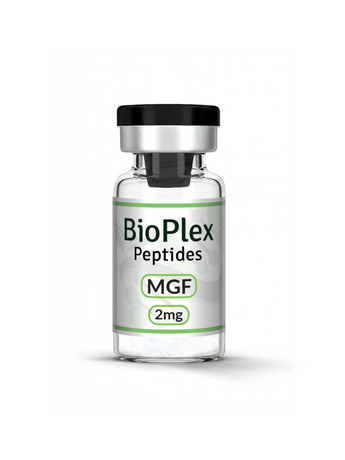


MGF 2mg(IGF-1Ec Peptide)
Couldn't load pickup availability
Premium Grade | UK Supply | Research Peptide | COA Certified | >99% Purity | Worldwide Delivery
(Tetracosapeptide, 24 amino acids)
Brief Summary
MGF, also known as Mechano Growth Factor, is a synthetic peptide studied in laboratory settings for its relationship with mechanically responsive tissue signalling, myogenic regulation and cellular adaptation pathways. The research peptide corresponds to the 24-amino-acid E-domain associated with the IGF-1Ec splice variant. Research has focused particularly on satellite-cell responses, myoblast proliferation, tissue-remodelling signals and locally regulated growth-factor pathways following mechanical stress. Unlike PEG-MGF, native MGF does not contain an attached polyethylene glycol chain and is therefore examined as the unmodified E-domain sequence. Within scientific research catalogues, MGF is valued for in vitro and preclinical investigation involving muscle-cell signalling, cellular proliferation, tissue adaptation and comparative IGF-1 splice-variant analysis. Its defined 24-amino-acid sequence supports structured laboratory study, analytical characterisation and reproducible peptide research within professional scientific environments.
Product Overview
MGF is a laboratory-grade synthetic peptide developed for controlled research into mechanically responsive cellular signalling, myogenic pathway activity and tissue-associated adaptation. Its 24-amino-acid sequence, YQPPSTNKNTKSQRRKGSTFEEHK, corresponds to the distinctive E-domain associated with the IGF-1Ec splice variant. This region is produced through alternative processing of the IGF-1 gene and differs structurally from mature IGF-1. MGF has been examined in myoblast and satellite-cell models, with particular attention given to cellular proliferation, differentiation timing, tissue-remodelling signals and responses to experimentally applied mechanical stress. The peptide is also relevant to comparative studies involving PEG-MGF, IGF-1 LR3 and other growth-factor-associated research compounds. Its defined composition and reproducible molecular characteristics support controlled investigation into peptide signalling, splice-variant biology, myogenic cellular responses and structure-activity relationships.
Scientific Background
From a molecular science perspective, MGF is studied as the E-domain peptide associated with a mechanically responsive IGF-1 splice variant. Alternative processing of IGF-1 transcripts produces different precursor forms containing distinct E-domain sequences. The MGF-associated E-domain has been investigated independently from mature IGF-1 to determine whether it produces separate cellular signalling responses. Experimental research has examined MGF in satellite-cell cultures, myoblast proliferation assays and tissue-response models involving mechanical loading or cellular stress. Its precise receptor interactions remain an area of continuing investigation, with research suggesting that some E-domain-associated activity may occur independently of classical IGF-1 receptor signalling. Comparative studies between native MGF and PEG-MGF also allow researchers to examine how polyethylene glycol attachment changes peptide stability and experimental observation periods. MGF therefore provides a useful molecular tool for investigating alternative gene processing, mechanically responsive signalling and myogenic cellular communication.
Research Applications
MGF is applied in laboratory research across peptide science, molecular biology, myogenic pathway investigation and cellular adaptation research. Researchers use the peptide to examine satellite-cell activation, myoblast proliferation, differentiation-associated markers and mechanically responsive signalling under controlled experimental conditions. Additional research applications include analysis of tissue-remodelling pathways, local growth-factor expression, protein-regulation markers and comparative evaluation against PEG-MGF or IGF-1-related compounds. MGF may also be used to investigate peptide stability, E-domain signalling and the influence of alternative IGF-1 transcript processing on cellular communication. Its 24-residue structure supports research into peptide conformation, sequence-specific activity, molecular recognition and structure-activity relationships. These applications contribute to a broader understanding of myogenic peptide biology and how mechanically responsive sequences may influence cellular adaptation pathways. MGF is supplied as a research compound for analytical, in vitro and controlled preclinical investigation only.
Technical Specifications
Contents: 2mg MGF
Form: Lyophilised powder
Purity: >99% (HPLC Verified)
Molecular Formula: C₁₂₁H₂₀₀N₄₂O₃₉
Molecular Weight: 2867.15 g/mol
Sequence: Tyrosine–Glutamine–Proline–Proline–Serine–Threonine–Asparagine–Lysine–Asparagine–Threonine–Lysine–Serine–Glutamine–Arginine–Arginine–Lysine–Glycine–Serine–Threonine–Phenylalanine–Glutamic Acid–Glutamic Acid–Histidine–Lysine
Peptide Length: 24 amino acids
pH Range: 5.0-7.0
Storage: Store between 1°C and 5°C
Note: Reconstitute with Bacteriostatic Water
Explore Related Research Compounds
Continue exploring related laboratory research products from BioPlex Peptides.
View PEG-MGF 2mg Research Compound ⟶
View IGF-1 LR3 1mg Research Compound ⟶
View Follistatin 1mg Research Compound ⟶
Research Preparation and Storage
Access BioPlex solutions, calculation tools and storage guidance for accurate and consistent laboratory preparation.
View Reconstitution Solutions ⟶
Use the Peptide Reconstitution Calculator ⟶
Read the Peptide Types and Storage Guide ⟶
Explore Related Research Articles
Continue your research with detailed BioPlex articles covering compound structures, scientific mechanisms and laboratory research pathways.
Disclaimer

More Ways to Pay — Coming Soon...
Why Thousands Choose BioPlex Peptides..
BioPlex has built its reputation through consistency, transparency and a long term commitment to quality. With peptide sector experience dating back to 2012, we've grown into one of the UK's most trusted research suppliers by focusing on high quality research products, independent verification and customer confidence—not empty marketing claims!
Explore BioPlex Research Collections
Browse research peptides UK, peptide sets, amino acids, SARMs, reconstitution solutions and the complete BioPlex product range.


Top Selling Product of 2026-Klow 80mg
KLOW is an 80mg multi-peptide research blend combining GHK-Cu, BPC-157, TB-500 and KPV. It supports controlled laboratory investigation into cellular signalling, extracellular matrix regulation, peptide interactions, inflammatory markers and coordinated tissue-response pathways.


Klow Stack 80mg
Couldn't load pickup availability
Your Recently Viewed Products...
Take another look at recently viewed products and continue exploring the BioPlex range.
New Research Arrivals & Liquid Amino-Acid Blends


Latest Articles From BioPlex ...
Research insights, industry updates and practical guidance from BioPlex Peptides.


Discover Our Sister Store — LoveVella
From the BioPlex family, discover LoveVella, our online adult and lifestyle store with thousands of products for women, men and couples. BioPlex customers can enjoy 15% off their LoveVella order.
CODE: BIOPLEXCUSTOMER
View The Sister Store⟶







)