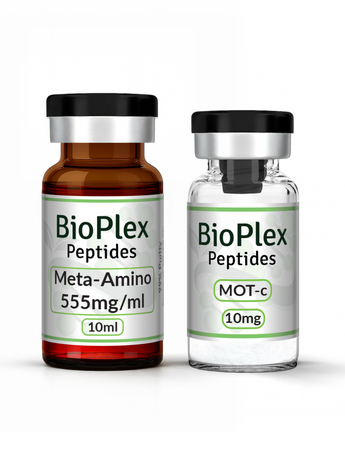


Meta-Amino 553mg/ml
Mots-c 10mg
Couldn't load pickup availability
Premium Grade | UK Supply | Research Peptide | COA Certified | >99% Purity | Worldwide Delivery
(Meta-Amino 10ml 553mg/ml – Seven Component Metabolic Amino Acid and Nutrient Research Blend)
(MOTS-c 10mg – Mitochondrial Derived Peptide, 16 Amino Acids)
Why Meta-Amino and MOTS-c Make a Strong Research Pairing
Meta-Amino 553mg/ml and MOTS-c 10mg form a scientifically relevant research pairing because they are investigated through complementary biochemical pathways associated with mitochondrial function, cellular energy metabolism, nutrient dependent enzyme activity and metabolic regulation. Although both products are relevant to metabolic research, they approach these biological systems through different molecular mechanisms. Meta-Amino provides a combination of amino acids, vitamins and metabolic cofactors, while MOTS-c introduces a mitochondrial derived peptide associated with cellular energy sensing, metabolic signalling and adaptive stress response pathways.
Meta-Amino 553mg/ml is a specialist liquid research formulation containing L-Carnitine, L-Methionine, Inositol, Choline, Vitamin B12, Vitamin B6 and NADH. These seven compounds contribute distinct but interconnected biochemical research profiles. L-Carnitine is investigated for its involvement in mitochondrial fatty acid transport, while L-Methionine participates in methylation associated metabolism and amino acid regulatory pathways. Choline and Inositol are studied in relation to phospholipid metabolism, cellular membrane organisation and intracellular signalling. Vitamin B6 and Vitamin B12 contribute to enzyme dependent amino acid metabolism and methylation pathways, while NADH is an important reduced coenzyme involved in cellular electron transfer and energy producing biochemical reactions.
MOTS-c is a mitochondrial derived peptide composed of 16 amino acids and encoded within the mitochondrial genome. It represents a distinctive class of signalling peptides associated with communication between mitochondrial activity and wider cellular regulatory systems. Scientific research has investigated MOTS-c for its relationship with metabolic stress responses, cellular energy sensing, AMPK associated signalling and mitochondrial to nuclear communication. Experimental studies have also explored its involvement in metabolic adaptation, glucose related signalling pathways and changes in cellular gene expression under defined laboratory conditions.
Studying Meta-Amino and MOTS-c within the same research programme provides an opportunity to investigate how nutrient dependent metabolic pathways relate to mitochondrial peptide signalling. Meta-Amino offers a research route into fatty acid metabolism, methylation chemistry, vitamin dependent enzyme activity and cellular redox systems, while MOTS-c provides a distinct perspective on mitochondrial signalling, cellular energy sensing and adaptive metabolic regulation. These complementary research profiles allow investigators to examine different aspects of mitochondrial biology within a broader experimental framework.
One area of particular scientific interest is the relationship between MOTS-c associated AMPK signalling and the metabolic processes represented by L-Carnitine and NADH within Meta-Amino. AMPK is a central regulator of cellular energy balance and responds to changes in intracellular energy availability. MOTS-c has been investigated for its potential involvement in AMPK related signalling and metabolic adaptation, while L-Carnitine participates in the transport of long chain fatty acids into mitochondria for beta oxidation. NADH contributes reducing equivalents to cellular electron transfer systems and is directly relevant to mitochondrial oxidative metabolism. Examining these pathways provides a useful framework for investigating cellular energy regulation from both peptide signalling and metabolic cofactor perspectives.
Meta-Amino also introduces several additional pathways associated with metabolic regulation and cellular communication. L-Methionine contributes to the methionine cycle and the production of S-adenosylmethionine, a major methyl donor involved in numerous biochemical reactions. Vitamin B12 participates in methionine synthase activity, while Vitamin B6 acts as a cofactor in amino acid metabolism and transsulfuration pathways. Choline contributes to phospholipid synthesis and methyl group metabolism, while Inositol is associated with membrane phospholipids and intracellular signalling systems. These compounds provide additional research opportunities for investigating how nutrient dependent biochemical reactions relate to metabolic regulation and cellular responses.
The pairing is particularly relevant to laboratory studies examining mitochondrial adaptation and metabolic stress. Mitochondria respond to changes in energy availability through interconnected systems involving nutrient utilisation, electron transfer, signalling proteins and changes in gene expression. MOTS-c is investigated as a mitochondrial signalling component within these adaptive processes, while Meta-Amino contains compounds associated with the biochemical machinery supporting cellular metabolism. This creates opportunities to examine relationships between mitochondrial peptide signalling, nutrient dependent enzyme function and cellular metabolic activity without assuming that the complete formulations produce an established synergistic effect.
Another important research area involves cellular redox regulation and mitochondrial communication. NADH participates in oxidation and reduction reactions and is closely associated with electron transport and energy metabolism. Vitamin B6 and Vitamin B12 contribute to metabolic enzyme systems, while MOTS-c has been investigated for its relationship with cellular stress responses and mitochondrial signalling pathways. Together, these research subjects provide a wider biochemical framework for examining how cellular energy status, mitochondrial communication and nutrient associated reactions influence metabolic regulation in experimental models.
Relevant experimental endpoints may include AMPK associated signalling activity, mitochondrial respiration, ATP related measurements, fatty acid oxidation markers, NADH dependent redox activity, glucose metabolism, mitochondrial gene expression, methylation associated biochemical markers and cellular stress response pathways. Additional investigations may examine phospholipid metabolism, enzyme cofactor activity, metabolic flexibility and changes in mitochondrial associated signalling proteins. These experimental measurements provide opportunities to assess the individual research profiles of Meta-Amino and MOTS-c and investigate relationships between their respective biochemical pathways. Direct synergistic effects between MOTS-c and the complete Meta-Amino formulation have not been established through controlled research.
A further advantage of this research set is that Meta-Amino 10ml and MOTS-c 10mg are supplied as separate research products. Meta-Amino is presented as a prepared liquid formulation containing seven metabolic research compounds, while MOTS-c is supplied as a lyophilised peptide powder. These separate presentations provide flexibility when investigating individual compound profiles, establishing experimental controls and comparing nutrient dependent metabolic activity with mitochondrial peptide signalling. Researchers can independently document sample concentration, preparation conditions, storage requirements, experimental timing and measured biochemical endpoints to support organised and reproducible laboratory investigation.
By bringing together a seven component metabolic amino acid and nutrient research formulation with a 16 amino acid mitochondrial derived peptide, this BioPlex set provides a practical and comprehensive option for laboratory investigation into mitochondrial function, AMPK associated signalling, cellular energy metabolism, fatty acid transport, methylation pathways, nutrient cofactor activity and adaptive metabolic regulation.
Disclaimer

More Ways to Pay — Coming Soon...
Why Thousands Choose BioPlex Peptides..
BioPlex has built its reputation through consistency, transparency and a long term commitment to quality. With peptide sector experience dating back to 2012, we've grown into one of the UK's most trusted research suppliers by focusing on high quality research products, independent verification and customer confidence—not empty marketing claims!
Explore BioPlex Research Collections
Browse research peptides UK, peptide sets, amino acids, SARMs, reconstitution solutions and the complete BioPlex product range.


Top Selling Product of 2026-Klow 80mg
KLOW is an 80mg multi-peptide research blend combining GHK-Cu, BPC-157, TB-500 and KPV. It supports controlled laboratory investigation into cellular signalling, extracellular matrix regulation, peptide interactions, inflammatory markers and coordinated tissue-response pathways.


Klow Blend 80mg
Couldn't load pickup availability
Your Recently Viewed Products...
Take another look at recently viewed products and continue exploring the BioPlex range.
New Research Arrivals & Liquid Amino-Acid Blends


Latest Articles From BioPlex ...
Research insights, industry updates and practical guidance from BioPlex Peptides.


Discover Our Sister Store — LoveVella
From the BioPlex family, discover LoveVella, our online adult and lifestyle store with thousands of products for women, men and couples. BioPlex customers can enjoy 15% off their LoveVella order.
CODE: BIOPLEXCUSTOMER
View The Sister Store⟶